The Amazigh World Assembly Calls on the Moroccan Parliament to Reactivate the Amazigh (berber) Issue
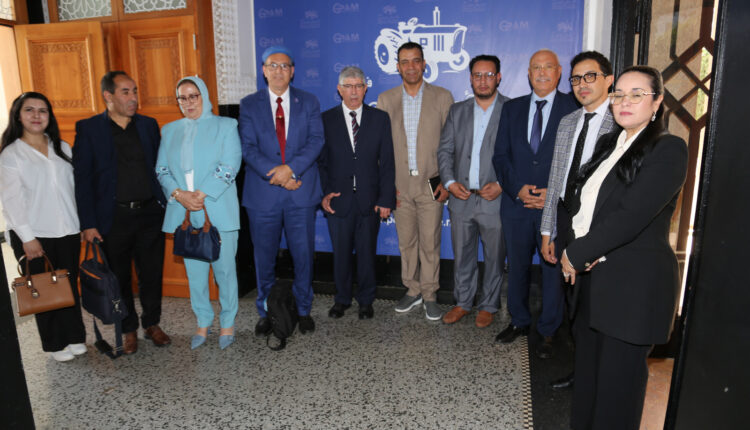
As part of its ongoing advocacy for the official recognition of the Amazigh language, a delegation from the Amazigh World Assembly held meetings during the week of May 18–22 with members of the parliamentary groups of the Socialist Union of Popular Forces (USFP), the Authenticity and Modernity Party (PAM), the Justice and Development Party (PJD), the Popular Movement (MP), and others, regarding the obstacles and difficulties related to the implementation of the official status of the Amazigh language and the application of the provisions of the Constitution and the relevant organic law.
The Amazigh representatives presented an overview of the main problems hindering the implementation of the official status of the Amazigh language, notably the very limited scope of its teaching, the difficulties faced by Amazigh language teachers, and the necessity of teaching Amazigh to children of the Moroccan diaspora, as well as its absence from adult literacy programs. The delegation also raised the issue of promoting Amazigh in public media and the audiovisual sector, criticizing what it described as the failure of national television channels to comply with the specifications regarding the presence of Amazigh language and culture.
The delegation also insisted on changing the name of the “Arab Maghreb Press Agency” so that it aligns with the preamble of the Constitution, replacing it with either “Greater Maghreb Agency” or simply “Moroccan Press Agency,” and demanded the urgent establishment of the “National Council of Moroccan Languages and Culture.”
Representatives of the parliamentary groups responded positively to the various requests made, expressing their readiness to intervene with the competent authorities and to raise these issues through questions and oversight initiatives within the legislative assembly. Below is the content of the Amazigh demands:
To the Esteemed Attention of the Presidents of the Parliamentary Groups
of the First Chamber of the Parliament of the Kingdom of Morocco
Subject: Request to Reactivate the Amazigh File
Excellencies,
We have the honor of submitting this request in order to draw your attention to an issue of great importance for the present and future of our country, namely the issue of Amazighity and its institutional promotion.
Allow us to bring to your attention that the United Nations Committee on the Elimination of Racial Discrimination (CERD) published, on December 8, 2023, its concluding observations regarding Morocco’s report, in which it examined the situation of the Kingdom and adopted concrete recommendations related to the Amazigh issue and the Amazigh language.
In this regard, the United Nations recommended that the Moroccan State intensify its efforts to implement the constitutional provisions and Organic Law No. 26-16 relating to the official character of the Amazigh language, and specifically recommended:
- Increasing the teaching of Amazigh at all educational levels, including preschool education, and increasing the number of Amazigh language teachers;
- Increasing the presence of Amazigh language and culture in audiovisual media;
- Ensuring that the Amazigh language is used on an equal footing with Arabic before the courts, including in pleadings and judgments;
- Redoubling efforts to ensure the effective use of Amazigh in official documents, including the National Electronic Identity Card.
Almost two and a half years have passed since the publication of these relevant and salutary UN observations and, despite our reminders addressed to our Minister of Foreign Affairs and government officials, little has materialized on the ground.
We also wish to emphasize that:
- Nearly a quarter of a century has passed since the historic Ajdir speech of His Majesty, delivered on October 17, 2001, in which he explicitly recognized the Amazigh identity of Morocco by emphasizing that: “Insofar as Amazigh constitutes a principal component of national culture, and a cultural heritage whose presence is manifested in all expressions of Moroccan history and civilization, we accord particular care to its promotion within the framework of implementing our democratic and modernist societal project, based on consolidating and valuing the Moroccan personality and its linguistic, cultural and civilizational symbols. The promotion of Amazigh is a national responsibility…”;
- The fifteenth year of the constitutional recognition of Amazigh within the Constitution of July 1, 2011, is underway, while Article 5 stipulates that: “Amazigh constitutes an official language of the State, as a common heritage shared by all Moroccans without exception”;
- Six years have passed since the promulgation of Organic Law 26-16 relating to the activation of the official character of Amazigh, without sufficient progress;
- Two years have passed since the official recognition of the Amazigh New Year, on which occasion His Majesty King Mohammed VI emphasized the place of “Amazigh as an essential component of the authentic Moroccan identity, enriched by the plurality of its tributaries, and a common heritage shared by all Moroccans without exception.”
We are sadly witnessing incomprehensible blockages and bureaucratic delays that severely hinder this ambitious project of promoting Amazighity, in contradiction with the royal will and constitutional provisions.
Excellencies,
The delegation of the international NGO “Amazigh World Assembly (AMA),” with whom you will have the pleasure of speaking, wishes to bring to your attention certain shortcomings and blockages that it has identified and which it respectfully enumerates below:
First: The National Council of Moroccan Languages and Culture
Let us recall that His Majesty took the initiative to create a royal committee tasked with drafting its organic law. The work of this committee, coordinated by Mr. Driss Khrouz starting in November 2015 and later submitted to the previous government, was unanimously voted and adopted by both Houses of Parliament in 2019. Its Dahir No. 04.16 was published in the Official Bulletin in April 2020, yet this institution has still not seen the light of day, six years after its adoption.
Consequently, we consider it your legislative duty to require the government to establish, as soon as possible, this important institution, namely the National Council of Moroccan Languages and Culture.
Second: The Generalization of Amazigh Language Education and the Revision of History Textbooks
The blockages coming from the Ministers of National Education, Preschool and Sports have become unacceptable due to their clear lack of political will to ensure the generalization of Amazigh language teaching from primary to secondary education, as well as its total exclusion from preschool education, despite its introduction into schools in 2003.
Despite our various protest letters addressed to the ministry, as well as our recommendations formulated at the conclusion of the 2nd National Forum of the Amazighs of Morocco, held in Khénifra in June 2023, aiming to raise the number of positions dedicated to recruiting Amazigh language teachers to 4,000, and despite the various letters sent to the ministry’s main international partners (World Bank, European Commission, French Development Agency…), we remain far from the generalization initially planned for 2008.
The “pioneer schools,” which the current minister claims will reform the Moroccan educational system, nevertheless exclude the second official, indigenous, and national language, namely Amazigh. He appears to have been inspired by the experience of Indian schools, whereas he should have drawn inspiration from a Moroccan experience that produced extraordinary and highly encouraging results, namely the network of Medersat.Com community schools of the BANK OF AFRICA-BMCE Bank Foundation.
Likewise, recent archaeological discoveries throughout our national geography (the Adrar Ighoud Man, Tafoghalt Man, Rabat Man, the discoveries of the Bismaoun cave in Mogador, the Ifri Amar or Moussa Man in Khémisset, the prehistoric village of Kach Kouch in Oued Laou, as well as the Paleolithic sites of Sidi Abderrahmane and Thomas Quarry in Casablanca…) require our educational authorities to deeply review and revise educational textbooks related to the collective memory that is history.
Third: Changing the Name of “MAP” to “Moroccan Press Agency”
We remind you that in 2018 our NGO, the World Amazigh Assembly, initiated legal proceedings against the “Arab Maghreb Press Agency (MAP).” The complaint filed before the Administrative Court of Rabat by Maître Mohammed Almou requested that the official agency change the designation “Arab Maghreb” to “Greater Maghreb,” in accordance with the amendment introduced into the preamble of the Moroccan Constitution.
We believe that the designation “Arab Maghreb Press Agency” carried — and still carries — a discriminatory title contrary to constitutional texts, human rights principles, and the geographical, historical, and archaeological realities of our country, Morocco, a pluralistic nation in linguistic, cultural, and religious terms.
In examining this case, the Administrative Court of Rabat issued decision No. 2061 dated 18/06/2018 in case No. 452/7110/2018, considering notably that this designation originates from the law and that only the legislative authority is competent to modify it.
This decision therefore constitutes an explicit referral of this issue to your legislative institution. Consequently, we ask you to open a new legislative debate aimed at amending the law governing this agency in order to bring it into conformity with the constitutional, legal, geographical, historical, and archaeological requirements of Morocco.
Fourth: The Integration of Amazigh in the Audiovisual Sector
Our public audiovisual media, funded by public money, such as TVM, SOREAD-2M, and Medi1 TV, continue to ignore constitutional provisions and persist in practicing discrimination against Amazigh identity by disregarding the provisions of Organic Law No. 26-16 relating to the official character of the Amazigh language.
On the occasion of the anniversary of the Revolution of the King and the People, on August 20, 2021, His Majesty the King rightly recalled that: “Morocco is targeted because it is a fully constituted State for more than twelve centuries, in addition to a long Amazigh history (…)”.
Despite this royal recognition of the Amazigh historical depth, journalists from several national information channels — including TV8-Tamazight — continue to use the ideologically loaded designation “Arab Maghreb,” in blatant contradiction with the preamble of the current Constitution, which now replaces it with the expression “Greater Maghreb.”
Through the recurrent use of terms such as “Arab peoples,” “Arab world,” “Arab homeland,” “Arab region,” “Arab Ummah,” “Arab Spring,” or even “Arab national football teams,” these media outlets wound, intentionally or unintentionally, millions of Moroccan Amazigh citizens, whether Amazigh-speaking, Arabic-speaking, Jewish, or French-speaking, including those living abroad.
Faced with this evident discrimination and the lack of documentary productions dedicated to Amazigh history, we have once again brought legal action against SOREAD-2M. In addition to failing to comply with the specifications imposing 30% of programs in the Amazigh language, this company also violates Article 14 of Organic Law 26-16, which provides that: “The criterion of the use of the Amazigh language shall be taken into account among those retained for the distribution of public subsidies intended for audiovisual productions, including cinematographic films, television films, and other artistic works.”
In this context, we ask you to intervene with the officials of the national audiovisual sector so that they fully respect their missions regarding cultural pluralism, freedom, openness, respect for human rights, preservation of human dignity, and the national cultural heritage in all its richness and diversity.
We also call for exceptional and concrete measures within a policy of positive discrimination in favor of promoting Amazighity.
Fifth: Tamazight TV8
As for the TV8-Tamazight channel, currently without a general director and which was supposed to play a key role in the normalization of the Amazigh language, it has instead reinforced regionalist dialectalization.
This channel, which was supposed to broadcast 24 hours a day and is mainly followed by Moroccans living abroad, especially in Europe, is often subject to justified criticism, particularly during Ramadan, because of programs lacking quality and substantial content.
This responsibility notably falls on the eight members of the program selection committee resulting from calls for tenders, a committee that has never been renewed since the channel’s creation in March 2010 and whose members, paradoxically, master neither the Amazigh language, nor the millennial history of the Amazighs, nor their anthropological characteristics, nor Amazigh values.
Due to obsolete ideological considerations stemming from pan-Arabism and ethnocentric visions, these officials censor documentary programs based on objective approaches to Amazigh history and recent prehistoric archaeological discoveries.
Sixth: The Total Absence of Amazigh Language Teaching for the Children of Moroccans Living Abroad (MRE)
Neither the Hassan II Foundation for Moroccans Living Abroad, nor the Ministry of National Education, nor the Ministry of Foreign Affairs, African Cooperation and Moroccans Living Abroad, nor the Council of the Moroccan Community Abroad (CCME) have coordinated efforts to introduce the Amazigh language — spoken by the majority of Moroccan communities established in Europe — into educational programs intended for MREs.
These programs remain limited solely to the “Program for Teaching the Arabic Language and Moroccan Culture,” which contributes to increasing school failure among many children in European schools and encourages certain social drifts (delinquency, drug trafficking, religious extremism, terrorism, regional separatism…)
It has become imperative to seriously question these institutions, particularly the Hassan II Foundation for MREs, so that they integrate the Amazigh language alongside Arabic and transmit to these generations the Amazigh values and the true history of their ancestors.
Seventh: The Total Absence of Amazigh Language Teaching in National Adult Literacy Campaigns
The Ministry of Habous and Islamic Affairs, headed by Mr. Ahmed Toufiq, as well as the National Agency for the Fight Against Illiteracy, continue to ignore, to this day, the integration of the Amazigh language into their programs and national adult literacy campaigns, especially in rural and mountainous areas, despite our repeated appeals insisting on the fundamental importance of the mother tongue.
This situation should evolve, especially since several committees of the United Nations High Commissioner for Human Rights continue to recommend that the Amazigh language receive the same treatment as the Arabic language, in accordance with the principle of equality between the two official languages of the State.
Excellencies,
In conclusion, based on the above, we submit these legitimate requests to seek your commitment, as representatives of the Moroccan people, to demonstrate political will and take the necessary initiatives so that the issue of Amazighity is placed among governmental priorities.
This would make it possible to effectively relaunch the project of promoting Amazighity in accordance with the spirit and philosophy of the Constitution, as well as in harmony with the speeches of His Majesty King Mohammed VI, may God assist Him.
Please accept, Excellencies, the expression of our highest consideration.
Signed: Rachid RAHA, President of the Amazigh World Assembly
Les commentaires sont fermés.