Does the European Union bear any responsibility for the recent tragic events in Ceuta and Melilla?
Your Excellencies,
- Ms. Ursula von der Leyen, President of the European Commission
- Mr. António Costa, President of the European Council
- Mr. Micheál Martin, Prime Minister of Ireland and President of the Council of the European Union (EU)
- Ms. Roberta Metsola, President of the European Parliament
- Ms. Kaja Kallas, High Representative of the European Union for Foreign Affairs and Security Policy and Vice-President of the European Commission
- And Members of the European Parliament,
Subject: Does the European Union bear any responsibility for the recent tragic events in Ceuta and Melilla?
Your Excellencies,
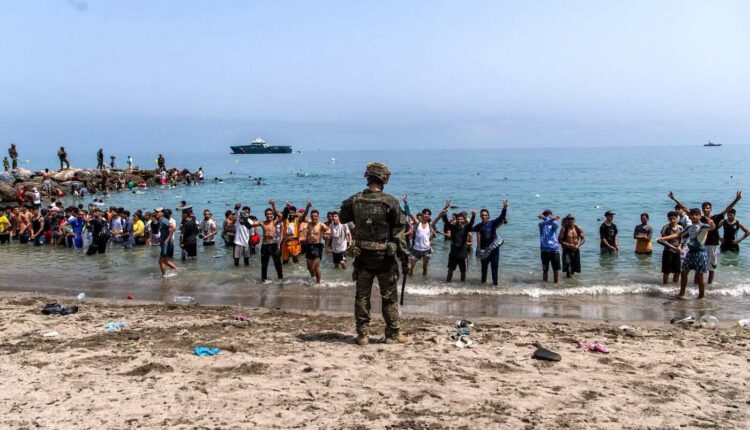
The tragic events related to the mass migration of young Moroccans towards the Spanish enclaves of Ceuta and Melilla, which unfortunately resulted in the deaths of 72 migrants, according to figures provided by the local authorities, including, sadly, a young Tetouan footballer, the late Faten Ben Omar El Azizi, have completely spoiled your summer holidays and triggered diplomatic disputes within your European Union countries, particularly between Spain and Italy. Moreover, they have forced you to convene your Interior Ministers to assess this unprecedented situation and formulate a response, following the illegal entry of more than 60,000 people!
Who is responsible for this unexpected attack on the European border and the Schengen Area? The Spanish Prime Minister has blamed “mafias” allegedly responsible for spreading the rumour, through social media, that the borders had been opened. Meanwhile, everyone is pointing the finger at the Moroccan authorities, who allegedly failed to mobilise in advance to stop this human tide heading towards the two Spanish enclaves in northern Morocco.
For my part, when I returned from Rabat to Melilla to spend my holidays at the superb Bokana beach, arriving at midnight on Thursday, 30 July, I found myself in the midst of these young adventurers and in front of a car they had overturned and set on fire. However, by quickly turning my 4×4 around, I was extremely fortunate that these desperate and uprooted young people did not throw stones at me, as they unfortunately did at the cars of Moroccans returning to their country.
Even though the Spanish authorities stated that more than 50,000 of them had already returned to Morocco, tensions remain high, and your reactions within the European Union to these unforgettable and shocking images of this migration crisis — including that of a person carrying his own mother on his back in order to migrate with her — have made headlines in the international press!
Honourable Representatives of the European Union,
Because of these dramatic events, I thought it would be appropriate to address you once again and insist on reminding you of my various letters, which you have stubbornly chosen to ignore.
What would you say if I described the European Union as a notorious accomplice, together with the Moroccan authorities, in these migration tragedies? Yes, some of your governments are indeed complicit, and I shall once again attempt to explain why.
You should know that the 60,000 people who managed to enter European territory represent only one fifth of the 300,000 Moroccan pupils who drop out of school every year, and only a tiny fraction of the 4.5 million young Moroccans without schooling or vocational training!
Indeed, the European Investment Bank (EIB) and your European Union allocated a budget of €102.5 million, to which was added €134.7 million from the French Development Agency (AFD), as well as contributions from other EU governments, to support the education reform provided for under the Moroccan Ministry of National Education’s “2022–2026 Roadmap”, with the aim of universalising preschool education and combating school dropout.
Consequently, it is legitimate to expect that your valuable financial assistance, raised through the sacrifices and taxes of your citizens across the various European states during these difficult times of austerity and war in Ukraine, should be used appropriately to combat the scourge of school failure and dropout and to improve the performance of the Moroccan education system, in the same way as aid provided for adult literacy.
Unfortunately, these noble objectives are never achieved for the simple reason that the educational authorities of the Kingdom of Morocco continue to disregard UNESCO recommendations concerning the importance of integrating the mother tongue into the school system, including in adult literacy programmes [1]. With regard to this educational issue, we have never ceased to challenge and denounce the Moroccan authorities over their inappropriate choice of language of instruction, without ever receiving a response from them [2].
The World Bank, for its part, continues to warn Morocco about the scale and alarming nature of school failure [3]. Its latest reports indicate that two thirds of pupils who complete primary school are unable to read or write properly in the languages of instruction — Modern Standard Arabic and French. This has not prevented us from repeatedly raising the issue with you [4], as well as with the French President [5] and his Minister of National Education, regarding the reasons for excluding the teaching of the official Amazigh language, which is also the mother tongue, from the education of the children of Moroccan citizens residing abroad, in June 2022 [6], whose number is beginning to exceed six million people.
As an international NGO defending Amazigh rights, we took the initiative to address several European embassies accredited in Rabat, beginning with that of the European Union [7], followed by those of Spain [8], Belgium [9], Germany, the Netherlands and, of course, France [10], all of which have significant Moroccan communities, the overwhelming majority of whom are of Amazigh (Berber) origin.
These various letters, submitted to the registry offices of the aforementioned diplomatic delegations, reiterated our legitimate demands for respect for our linguistic and cultural rights as Amazigh people. We pointed out that, since Organic Law No. 26.16 on the implementation of the official status of the Amazigh language officially entered into force after being unanimously adopted by both chambers of Parliament and published in the Official Gazette under No. 6816 on 26 September 2019 [11], we urged you not to forget to include the Amazigh language in all educational programmes and bilateral agreements, and more particularly in bilateral agreements with the Kingdom of Morocco concerning “Education in the Language and Culture of Origin” (ELCO).
Nor should its integration into your schools and/or institutes located in the capital, Rabat, or in other Moroccan cities, or into partner NGOs, be overlooked. Above all, consideration should be given to including Amazigh in adult literacy programmes and development programmes intended for rural women, while also organising social, cultural, artistic and academic activities within your cultural centres to promote knowledge and awareness of Amazigh culture and civilisations.
We also ask you to respect the historical identity of the whole of North Africa by avoiding the discriminatory designation of the “Arab Maghreb”, which deeply hurts the feelings, sensitivities, identity and pride of millions of your own citizens originating from “North Africa” or “Tamazgha”.
What deeply angers us is that some of your governments act as if Morocco had never adopted its constitutional reform following the 20 February Movement of 2011, and that the latest agreements signed within the framework of the so-called “High-Level Summits” between the Moroccan government and the Spanish government, on 4 December 2025, and the French government, on 16 July 2026, as well as their bilateral educational agreements concerning “teachers of the Arabic language and Moroccan culture” for the children of Moroccans residing in Europe, provide for no Amazigh-language teachers within “your own European schools”.
This situation is desperately at odds with the spirit of the new Moroccan Constitution and the latest United Nations recommendations, which Minister Nasser Bourita has ignored [12], whose fundamental objective is to call upon the Moroccan authorities to intensify their efforts to ensure that Amazigh people are not victims of racial discrimination in the exercise of their fundamental rights, particularly in the field of education.
Ultimately, given that Europe’s future is intimately linked to that of Tamazgha [13], you, as representatives of the EU Member States and of the European peoples, are necessarily called upon to put pressure on the Moroccan government to respect human rights, its own Constitution and, more specifically, Article 5 concerning the co-official status of its national and indigenous language, namely the Amazigh language.
It is therefore necessary to integrate the Amazigh mother tongue into educational programmes and bilateral agreements with your countries, all the more so because we are firmly convinced that you care about the future of this North African country, which already enjoys advanced status with the EU.
In the hope that my modest letter of appeal will receive a positive response and your attentive consideration, please accept, Your Excellencies, Honourable Representatives of the EU and Members of the European Parliament, the assurances of my highest consideration.
Rachid RAHA, President of the Amazigh World Assembly (AMA)
Notes :
[8]- https://amadalamazigh.press.
& https://amamazigh.org/2022/11/
[11]- https://amadalamazigh.press.
[13]- https://amamazigh.org/2021/06/
Les commentaires sont fermés.