Why Are Moroccans Not Arabs?
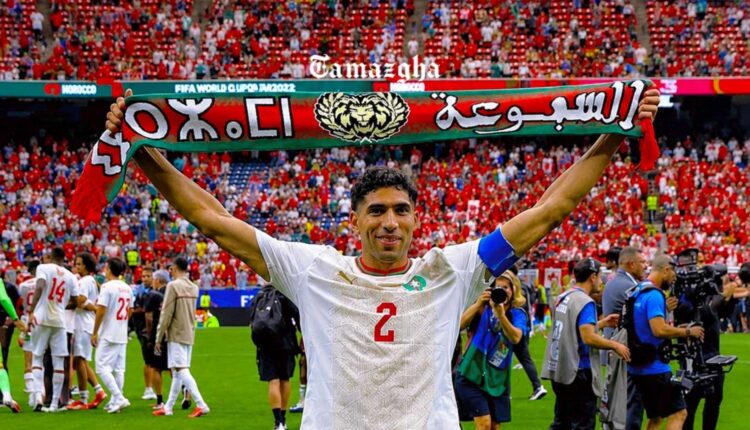
Following the football match played on Tuesday June 30th morning between Morocco and the Netherlands, I found myself once again reflecting on this obvious question: are Moroccans Arabs?
I previously had the opportunity to address this issue with Ms. Elena Sánchez Caballero [1], then acting president of RTVE (Spanish Radio and Television Corporation), criticizing RTVE’s news broadcasts which, during the 2022 FIFA World Cup in Qatar, offended the sensibilities of Moroccan and African citizens by referring to the Moroccan national team as an “Arab team.” At the time, Morocco had qualified for the quarterfinals of the competition. In my letter, I emphasized that the players of this neighboring southern Mediterranean country represented all Moroccans and North Africans, who are “Amazigh”(Berbers) [2], and are in no way “Arabs” from the Asian continent. I pointed out, however, that if the team were described as “Moors,” this would pose no problem, since the term is even more appropriate and derives from “maurus,” itself originating from “mis tamurt.” In Amazigh, this means “sons of the land,” an expression referring to the ancient inhabitants of Mauretania Tingitana, the name given to Morocco during the Roman era. The word Morocco itself is a contraction of “tamurt n Yakuch,” meaning the land of God.
At that time, I received an unsatisfactory response from Ms. María San Juan, from RTVE’s Public Ombudsman team, who persisted in describing Morocco and its inhabitants as “Arabs.” I felt compelled to send her another letter, reaffirming that “the Kingdom of Morocco has never been an Arab country and, like all other North African countries, it never will be.” Why?
In my response, I highlighted the example of the FIFA Club World Cup final between Real Madrid (Spain) and Al-Hilal (Saudi Arabia), played on Saturday, February 11, 2023, in Rabat. That match generated immense enthusiasm, high expectations, and palpable excitement. Do you remember which team the Moroccan public, and by extension the Amazigh public of North Africa, supported? I pointed out to the RTVE mediator that, according to their statements, Moroccan (and Amazigh) masses should have sided with the Saudis, since they are supposedly “Arab” and “Muslim” brother peoples. Well, no! The Moroccan public passionately and convincingly cheered for the “Spanish” and “Christian” team. Moroccans supported the Spanish “infidels” instead of their brothers in “Arabness” and “Islamic religion”! It is almost the same situation as the Morocco-Netherlands match, where Mexican Catholics were expected to support the Christian Dutch rather than Muslim Moroccans, and Algerians, supposedly “Arab” and “Muslim” brothers, were expected to support Moroccan footballers rather than the Dutch.
 In reality, as our eminent scholar Mohamed Chafik emphasized in his study “The Berbers and Their Contribution to the Development of Mediterranean Cultures”: “May our Arab coreligionists understand that non-Arabs also have the right to be proud of their identity! The Berbers (Imazighen) simply want to be Berbers (Imazighen), just as the Chinese are Chinese, the Japanese are Japanese, and the Arabs are Arabs.”
Let us not forget that when Morocco submitted its bid for the 2026 FIFA World Cup, Arab countries such as Saudi Arabia, the United Arab Emirates, Kuwait, Iraq, Jordan, and Lebanon preferred to vote in favor of the “infidel” Yankees rather than for the “fake Arabs” who, in their eyes, include all the inhabitants of North Africa.
However, as the 2030 FIFA World Cup approaches, which Morocco will co-host with Spain and Portugal, we continue to draw the attention of the leaders of the three football federations of the western Mediterranean, and particularly that of Mr. Fouzi Lakjaa [3], president of the Royal Moroccan Football Federation (FRMF), in order to express our deep disappointment at the persistent discrimination suffered by the Amazigh language and culture.
During the presentation of the 2030 FIFA World Cup on October 28, 2023, in Rabat, in the presence of Mr. Pedro Rocha, president of the FRMF, and Mr. Fernando Gomes, president of the FPF, no mention was made of this language and culture, despite them being an integral part of Moroccan identity, neither in the logo nor on the posters displayed during the roundtable discussion. The rich and shared history of these three countries was also ignored. Consequently, we categorically reject any interpretation of this exclusion as a falsification and mutilation of our collective memory. It is our duty to emphasize the role of the ancient Amazighs as builders of Mediterranean civilizations and their contribution to the formation of Andalusian civilization.
It would be highly useful and of great interest to recall history and, in particular, the idea that the ancient Amazighs contributed to the creation of these Mediterranean civilizations, especially Iberian civilization, even before the arrival of the Phoenicians and the rise of the Roman Empire. This is confirmed notably by the anthropological genetics studies of the prestigious Spanish immunologist Professor Dr. Antonio Arnaiz Villena, from the Complutense University of Madrid [4], who asserts that Iberians and Amazighs share the same North African origins. Along the same lines, the renowned scholar Mohamed Chafik writes [5]: “Out of all these vicissitudes of history, it emerged that Amazigh elites became acculturated in various ways and richly contributed to the development of the great Mediterranean cultures.” Furthermore, the Amazigh people of Morocco, known as “Moros” among our Iberian neighbors, deserve historical recognition for having built a remarkable common civilization over eight centuries: the Muslim civilization of medieval Andalusia, from the conquest of Gibraltar by the Amazigh Tariq ibn Ziyad in 711 to the expulsion of the last Moriscos from the Alpujarras, in the province of Granada, in 1609. In this regard, it would be appropriate for tourism officials on both sides of the western Mediterranean to revive and further develop the ambitious project of the “Andalusian Legacy” Foundation concerning tourism routes linked to Andalusian heritage, a project initiated by the lawyer Jerónimo Páez in 1995.
 On February 17, on the occasion of the thirty-seventh anniversary of the creation of the Arab Maghreb Union (AMU), I took the initiative of asking the foreign ministers of Morocco, Algeria, Mauritania, Tunisia, and Libya to dissolve this Union. The “Arab Maghreb Union” (AMU) [6] completely failed because it was built upon the denial of the ancient history of North Africa and of the authentic Amazigh-African identity, adopting a reductive, discriminatory, and inappropriate designation: “Arab Maghreb.” It was essentially based on an imported, artificial, and imposed ideology — “Arab-Islamism” — which lies at the origin of the decline of this regional entity [7].
Consequently, the 35th edition of the Africa Cup of Nations 2025, recently organized in Morocco, offered a striking illustration of this reality. The total lack of solidarity among North African supporters was evident: Moroccan supporters backing the Congolese or Nigerian national teams against Algeria; Algerian and Tunisian supporters openly expressing satisfaction after Morocco’s controversial defeat in the final against Senegal; and Moroccan supporters enthusiastically celebrating Nigeria’s victory over Egypt, the country where Gamal Abdel Nasser elevated pan-Arabism into a state religion.
Regarding this resounding failure of the Arab Maghreb Union (AMU), His Majesty King Mohammed VI of Morocco, during his speech at the 28th African Union Summit in Addis Ababa on January 31, 2017 [8], declared:
“Morocco has always believed that strength must first be drawn from the integration of its Maghreb sub-region. Yet it must be acknowledged that the flame of the AMU has gone out because faith in a common interest has disappeared!
The mobilizing momentum of the Maghreb ideal promoted by the pioneering generations of the 1950s has been betrayed. Today, we regretfully observe that the AMU is the least integrated region on the African continent, if not in the entire world…”
In short, we call on all journalists, intellectuals, and academics from the three countries bordering the Strait of Gibraltar to use realistic terminology free from ideological bias and from the promotion of a decadent Arab nationalism, at the expense of scientific objectivity, recent archaeological discoveries, and historical truth. Therefore, we will continue to recommend avoiding expressions such as “Arab team,” “Arab football,” “Arab Maghreb,” “Arab Ummah,” “Arab nation,” or “Arab Spring”… Be aware that these terms deeply offend the sensibilities, identity, and pride of millions of Moroccan and Amazigh citizens, as well as millions of emigrants or European citizens of Amazigh origin living in Spain, France, Belgium, Germany, the Netherlands, Italy, and Portugal. Whenever the “Atlas Lions” win a match, such as the recent one played in Mexico, these people take to the streets waving Moroccan and Amazigh flags in the major cities of the European Union.
The success of these young Moroccan Amazigh footballers, as well as the recent opening of the Amazigh Museum within the Alhambra complex in Granada [9] — unfortunately ignored by the Spanish national press — invite us to deepen our research and organize more Hispano-Portuguese-Moroccan cultural events in order to strengthen our understanding of Amazigh culture, which has united these three countries for millennia but remains one of the most neglected subjects in their universities and intellectual circles.
Rachid Raha, President of the Amazigh World Assembly and the David Montgomery Hart Foundation for Amazigh Studies
Notes:
[1]- https://rachidraha.com/
[2]- www.amadalamazigh.press.
[3]- https://amazigh24.com/
[4]- Dr. Antonio Arnaiz Villena & Jorge Alonso García: Egipcios, Bereberes, Guanches y Vascos”, Editorial Complutense de Madrid, 2000.
[6]- https://amamazigh.org/
Les commentaires sont fermés.