Some regional autonomous communities of Spain, governed by the center-right Popular Party (PP) and the far-right Vox party, have begun seriously considering the abolition of the “Program for the Teaching of the Arabic Language and Moroccan Culture” in public schools in the Community of Madrid and Murcia [1]. This program is currently implemented in nearly 400 schools across 12 autonomous communities.
This linguistic and cultural program is part of bilateral cooperation between the governments of the Kingdoms of Morocco and Spain and is funded by the Hassan II Foundation for Moroccans Living Abroad. A similar program has also been signed between Morocco and other European countries such as France, Germany, Belgium, the Netherlands, Portugal, and Italy, in reference to the bilateral agreements concerning the “Teaching of the Language and Culture of Origin (ELCO)”, implemented under a European directive of July 25, 1977, aimed at ensuring the education of children of migrant workers.
Among the main objectives of this program are:
- To teach the Arabic language and Moroccan culture to Moroccan students enrolled in European schools.
- To offer Moroccan students an education that enables them to preserve their identity and live their culture while respecting that of the host country.
- To ensure the academic and sociocultural inclusion of these students in the European educational system and society by promoting values of tolerance and solidarity.
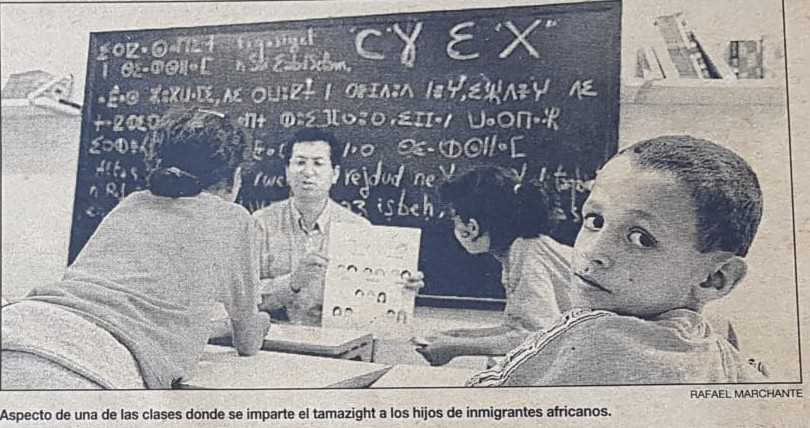
According to Moroccan authorities, this program helps improve the self-esteem of Moroccan students and strengthen their connection with immigrant families, by providing education designed to preserve their national identity and allow them to live their culture in harmony with that of the host country. Unfortunately, the noble objectives of this ambitious “Program for the Teaching of the Arabic Language and Moroccan Culture” have not yielded any positive results. Its resounding failure can be explained by one simple reason: the native language of these students is not Classical Arabic at all, but rather the Amazigh (Berber) language or Darija (known as dialectal, colloquial, or popular Arabic) [2].
This program, coordinated and funded by the Hassan II Foundation for Moroccans Living Abroad and promoted by its Deputy President and eminent royal adviser, Mr. Omar Azziman, instead of improving the academic performance of Moroccan children or combating school failure, ends up uprooting their identity, falsifying the history of their country of origin—challenged today by the latest archaeological discoveries—and, of course, wasting public money [3]. Why?
Because, as I recently emphasized before the Director-General of UNESCO [4], this program contravenes the following provisions:
- The Royal Directives expressed in the Ajdir Speech of October 17, 2001, in which His Majesty King Mohammed VI stated:
“Since Amazigh constitutes a fundamental component of national culture and a cultural heritage present in all expressions of Moroccan history and civilization, We accord it special attention as part of the implementation of Our project for a democratic and modern society, based on strengthening Moroccan identity and its linguistic, cultural, and civilizational symbols…” - The Constitution of July 1, 2011, whose Article 5 clearly stipulates: “Likewise, Amazigh constitutes an official language of the State, as a common heritage for all Moroccans without exception…”
- Organic Law No. 26.16, defining the stages for implementing the official status of Amazigh and its integration into education and key areas of public life, adopted unanimously by both Houses of Parliament in 2019 (Dahir No. 1-19-121 of 12 Muharram 1441 / September 12, 2019) [5].
- UN recommendations, notably those of Ms. Tendayi Achiume, Special Rapporteur on contemporary forms of racism, racial discrimination, xenophobia, and related intolerance, following her visit to Morocco in December 2018 [6], as well as the concluding observations of the Committee on the Elimination of Racial Discrimination (CERD) regarding Morocco’s report, on December 8, 2023 [7].
- The International Convention on the Rights of the Child (1989), whose Article 8 obliges States Parties to respect the child’s right to preserve his or her identity, including linguistic identity.
UNESCO recommendations, especially the statement by Ms. Audrey Azoulay on the occasion of the 25th anniversary of International Mother Language Day [8]: “Rather than seeing this linguistic variety as a source of incomprehension, we should instead value its cultural and cognitive benefits. Recognizing the benefits of the world’s languages means, first and foremost, allowing all people to learn in their native languages. This is especially important in the early years of schooling, when basic reading and writing skills are acquired, and national languages are gradually introduced. The research on this subject is clear. The new UNESCO report published on the occasion of the Day – Languages matter: global guidance on multilingual education– is a reminder of the many ways in which multilingualism furthers education. More children will attend school and perform well if they learn in their mother tongue. They also feel fully accepted when they are spoken to in their mother tongue at schooland are better equipped to learn new languages…”
In conclusion, it is impossible to ensure the proper integration of children of Moroccan migrant workers into European schools through multicultural education programs such as “Teaching of the Language and Culture of Origin (ELCO)”, if these programs are not clearly based on their true mother tongue, which is Amazigh or Darija—and certainly not Classical Arabic.
By Rachid RAHA
President of the World Amazigh Assembly
Notes:
[5]- https://amadalamazigh.press.ma/pdf/26.16.pdf
[8]- https://unesdoc.unesco.org/ark:/48223/pf0000392824